

Frequently Asked Questions
What Is The Constitutional Provision On Protection To Labor?
“The State shall afford full protection to labor, local and overseas, organized and unorganized, and promote full employment and equality of employment opportunities for all. It shall guarantee the rights of all workers to self-organization, collective bargaining and negotiations, and peaceful concerted activities, including the right to strike in accordance with law. They shall be entitled to security of tenure, humane conditions of work, and a living wage. They shall also participate in policy and decision-making processes affecting their rights and benefits as may be provided by law.
“The State shall promote the principle of shared responsibility between workers and employers and the preferential use of voluntary modes in settling disputes, including conciliation, and shall enforce their mutual compliance therewith to foster industrial peace.
“The State shall regulate the relations between workers and employers, recognizing the right of labor to its just share in the fruits of production and the right of enterprises to reasonable returns on investments, and to expansion and growth.”
What Rules Govern The Proceedings Before The Labor Arbiters And The NLRC?
The proceedings before the Labor Arbiters and the NLRC are governed by the Labor Code, as amended, the 2011 NLRC Rules of Procedure, and suppletorily, the Rules of Court.
What Is The Nature Of The Proceedings Before The Labor Arbiter?
The NLRC Rules describe the proceedings before the Labor Arbiter as non-litigious. Subject to the requirements of due process, the technicalities of law and procedure in the regular courts do not apply in the labor arbitration proceedings.
What Are The Cases Falling Under The Jurisdiction Of The Labor Arbiters?
Under Article 217 of the Labor Code, Labor Arbiters have jurisdiction over the following cases:
1. Unfair labor practice (ULP) cases;
2. Termination disputes (or illegal dismissal cases);
3. If accompanied with a claim for reinstatement, those cases that workers may file involving wages, rates of pay, hours of work and other terms and conditions of employment;
4. Claims for actual, moral, exemplary and other forms of damages arising from employer-employee relations;
5. Cases arising from any violation of Article 264 of the Labor Code, including questions involving the legality of strikes and lockouts;
6. Except claims for employees compensation not included in the next succeeding paragraph, social security, medicare and maternity benefits, all other claims arising from employer-employee relations, including those of persons in domestic or household service, involving an amount exceeding Five Thousand Pesos (P5,000.00), whether or not accompanied with a claim for reinstatement;
7. Wage distortion disputes in unorganized establishments not voluntarily settled by the parties pursuant to Republic Act No. 6627;
8. Enforcement of compromise agreements when there is non-compliance by any of the parties pursuant to Article 227 of the Labor Code, as amended;
9. Money claims arising out of employer-employee relationship or by virtue of any law or contract, involving Filipino workers for overseas employment, including claims for actual, moral, exemplary and other forms of damages as provided by Section 10 of R.A. No. 8042, as amended by R.A. No. 10022;
10.Contested cases under the exception clause of Article 128(b) of the Labor Code, as amended by R.A. 7730; and
11.Other cases as may be provided by law.
May A Non-Lawyer Appear In Any Of The Proceedings Before The Labor Arbiter Or Commission?
Yes. A non-lawyer may appear in any of the proceedings before the Labor Arbiter or Commission only under the following conditions:
1. he/she represents himself/herself as party to the case;
2. he/she represents a legitimate labor organization, as defined under Article 212 and 242 of the Labor Code, as amended, which is a party to the case: Provided, that he/she presents to the Commission or Labor Arbiter during the mandatory conference or initial hearing: (i) a certification from the Bureau of Labor Relations (BLR) or Regional Office of the Department of Labor and Employment attesting that the organization he/she represents is duly registered and listed in the roster of legitimate labor organizations; (ii) a verified certification issued by the secretary and attested to by the president of the said organization stating that he/she is authorized to represent the said organization in the said case; and (iii) a copy of the resolution of the board of directors of the said organization granting him such authority;
3. he/she represents a member or members of a legitimate labor organization that is existing within the employer’s establishment, who are parties to the case: Provided, that he/she presents: (i) a verified certification attesting that he/she is authorized by such member or members to represent them in the case; and (ii) a verified certification issued by the secretary and attested to by the president of the said organization stating that the person or persons he/she is representing are members of their organization which is existing in the employer’s establishment;
4. he/she is a duly-accredited member of any legal aid office recognized by the Department of Justice or Integrated Bar of the Philippines: Provided, that he/she (i) presents proof of his/her accreditation; and (ii) represents a party to the case;
5. he/she is the owner or president of a corporation or establishment which is a party to the case: Provided, that he/she presents: (i) a verified certification attesting that he/she is authorized to represent said corporation or establishment; and (ii) a copy of the resolution of the board of directors of said corporation, or other similar resolution or instrument issued by said establishment, granting him/her such authority.

Smart FAQ
Ask Anything from NLRC Website and FAQ, etc.

Smart Q&A
Learn more about NLRC Freedom of Information (FOI) requests, etc.

Job Application
Chat-based job recruitment and interview.
Solution Overview
Conversational AI
Is the set of technologies behind automated messaging and speech enabled human-like interactions between people and computers. It refers to technologies like chatbots and virtual assistants that users can talk to as they would with human agents.
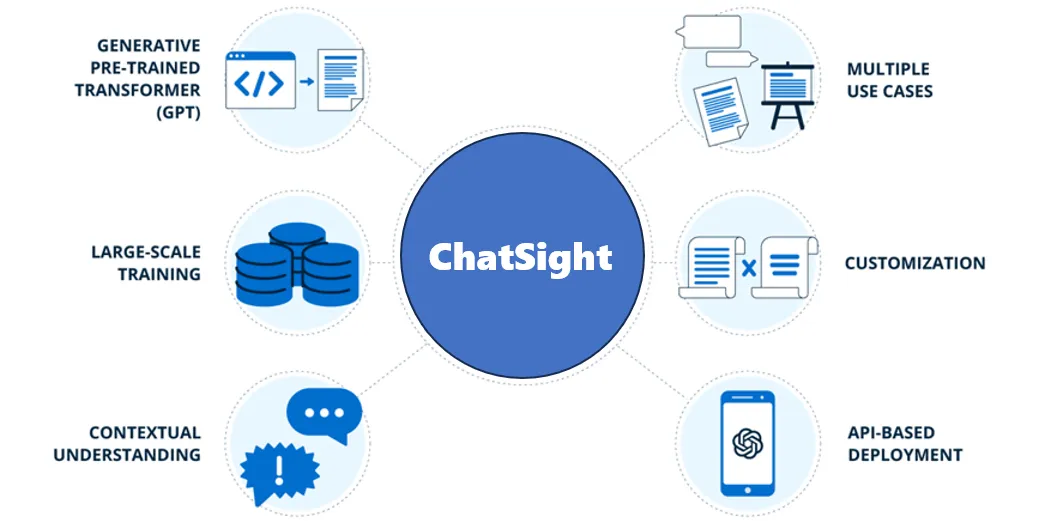
ChatSight is a suite of chat-based generative AI solution developed by IALCHEMY. At its core, it's a pre-trained large language model that is grounded and customized for specific use cases. It generates human-like text based on the input and utilizes patterns in the data that it was trained on to generate creative, relevant responses.
Key Industry Trends

Business Messaging
Is the way brands initiate and respond to customers over various messaging channels. It empowers customers to reach out to brands and enables brands to reach out to customers.

Chat User Experience
Chat UX refers to the quality of interaction and engagement a user has with a chatbot or a chat-based interface. It is an increasingly important focus for businesses and developers. An emerging trend in UI.

Generative AI
Is a type of Artificial Intelligence that can create a wide variety of data, such as text, images, videos, audio, and 3D models. Foundation models
like GPT-4, a type of generative AI, are trained on a large corpus of diverse data from the internet, and can generate creative and coherent outputs in response to a wide range of inputs.
How Conversational AI Works
Conversational AI technology is shaping the future of human-computer interaction. By mimicking human conversation, it enables computers to understand, process, and respond to natural language, facilitating a more intuitive and personalized user experience.
STEP 1: Understanding User Input
STEP 2: Determining Best Response
STEP 3: Delivering Human-like Output
Involves Natural Language Understanding (NLU), a component of NLP. When a user inputs text or speech, NLU processes the information, breaking it down into components and extracting the intended meaning. It's capable of recognizing and understanding diverse linguistic elements, including syntax, semantics, sentiment, and context.
Leverages Machine Learning algorithms to determine the best response or action. The decision-making process depends on the system's purpose or the AI's role, i.e. Customer Service Assistant. This is where AI’s ability to learn from past interactions comes into play, allowing it to improve its responses over time and provide dynamic user interaction.
Employs Natural Language Generation (NLG), a vital part of NLP, to create a suitable response. The structured data, representing the decided response from the system, is translated by NLG into natural, human-like language. This generated response is then shared with the user, delivering the output to complete one interaction cycle.
.